
Uncategorized
Hellcat Engine Transmission Compatibility Guide
Aug
Choosing the wrong transmission for a Hellcat swap is an expensive mistake. The 6.2L supercharged HEMI produces 650 lb-ft of torque at 4,000 rpm in standard configuration. Not every transmission handles that load reliably, and not every transmission physically connects to the Gen III HEMI bellhousing without an adapter.
This guide covers every transmission option that works with the Hellcat engine, what each one requires, what to confirm before purchasing, and what separates a transmission that handles the job from one that does not.
Understanding the Gen III HEMI Bellhousing Pattern
Before selecting a transmission, understand the physical connection point. The Hellcat uses the standard Gen III HEMI bellhousing bolt pattern. This pattern is specific to Chrysler’s modern HEMI family and is not the same as the small block Mopar pattern from the 1960s and 1970s, the LS bellhousing pattern, or any Ford bellhousing pattern.
Any transmission that does not natively mate to the Gen III HEMI bellhousing pattern requires an adapter plate. The adapter fills the gap between the two bolt patterns and positions the transmission input shaft correctly relative to the crankshaft centerline.
Adapter quality matters significantly. A poorly made adapter introduces misalignment that accelerates input shaft bearing wear, pilot bearing wear, and clutch disc wear on manual applications. Confirm the adapter you source is machined to close tolerances from a supplier with documented experience in Gen III HEMI applications.
Factory Hellcat Transmission Pairings
Chrysler paired the Hellcat with two factory transmission options depending on the model year and vehicle configuration.
TorqueFlite 8HP90 Eight-Speed Automatic
The 8HP90 is the primary factory transmission pairing for the Hellcat across most model years and applications. It is a ZF-designed unit licensed and assembled by Chrysler, sharing the same basic architecture as the ZF 8HP family used across multiple manufacturers.
Key specifications:
| Specification | Details |
|---|---|
| Type | 8-speed automatic |
| Manufacturer | ZF / Chrysler |
| Torque capacity | Rated above 800 lb-ft in factory configuration |
| Gear ratios | 1st: 4.714, 2nd: 3.143, 3rd: 2.106, 4th: 1.667, 5th: 1.285, 6th: 1.000, 7th: 0.839, 8th: 0.667 |
| Overdrive | Yes, two overdrive gears |
| Control | Electronic, integrated with factory PCM |
| Applications | Challenger SRT Hellcat, Charger SRT Hellcat, all variants |
The 8HP90’s torque capacity comfortably exceeds the standard Hellcat’s 650 lb-ft and the Redeye’s 707 lb-ft in factory trim. For swap applications retaining the 8HP90, the transmission control module requires compatibility with your ECU solution. The 8HP90 uses electronic shift control that communicates directly with the factory PCM. A standalone engine management system for a swap application needs to either control the 8HP90 electronically or work alongside a separate transmission controller.
Several aftermarket standalone 8HP90 transmission controllers exist that allow the transmission to function correctly outside the factory vehicle application. Confirm your ECU and transmission control solution are compatible before committing to the 8HP90 in a swap application.
Tremec TR-6060 Six-Speed Manual
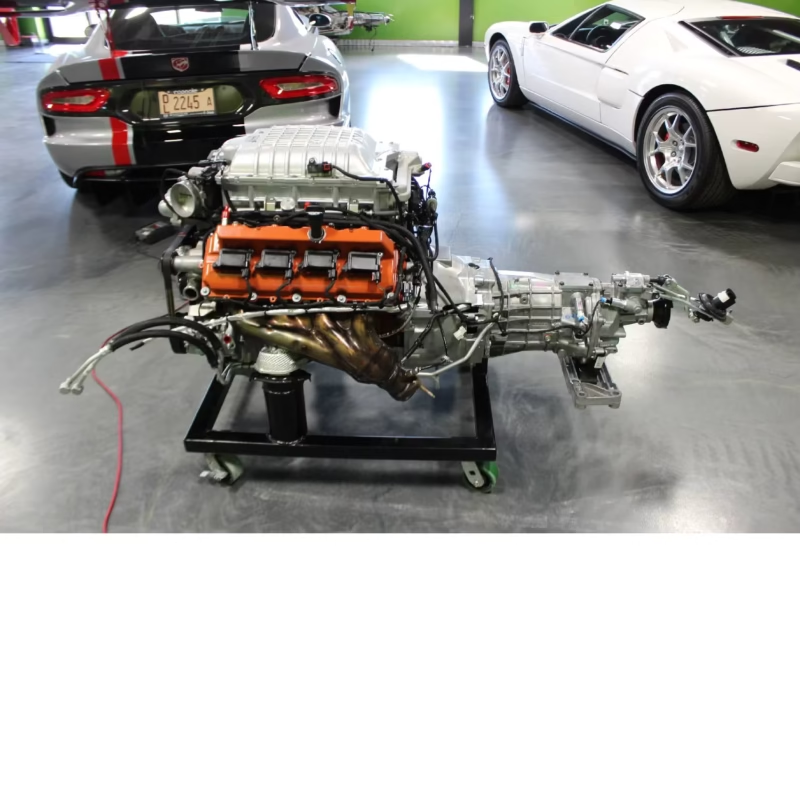
The TR-6060 is the factory manual transmission pairing for the Hellcat in Challenger applications. It is a Tremec-manufactured six-speed that Chrysler specifies for the Hellcat’s output level and the Challenger’s performance application.
Key specifications:
| Specification | Details |
|---|---|
| Type | 6-speed manual |
| Manufacturer | Tremec |
| Torque capacity | Approximately 650 lb-ft |
| 1st gear ratio | 2.66 |
| 2nd gear ratio | 1.78 |
| 3rd gear ratio | 1.30 |
| 4th gear ratio | 1.00 |
| 5th gear ratio | 0.74 |
| 6th gear ratio | 0.50 |
| Reverse ratio | 2.90 |
| Applications | Challenger SRT Hellcat, select manual variants |
The TR-6060’s rated torque capacity sits at approximately the standard Hellcat’s peak torque figure. For street use at factory power levels, the TR-6060 handles the application correctly. For significantly modified Hellcat engines producing torque beyond the factory specification, the TR-6060’s capacity margin becomes tighter and transmission longevity under sustained hard use is affected.
For swap applications, the TR-6060 mates directly to the Gen III HEMI bellhousing without an adapter. This makes it the most straightforward manual option for a Hellcat swap from a fitment standpoint. The physical length of the TR-6060 and its shifter position need to be confirmed against your specific chassis tunnel dimensions before committing to this transmission.
Aftermarket and Swap Transmission Options
Tremec TKX Five-Speed Manual
The Tremec TKX is a compact five-speed manual designed specifically for the performance street and swap market. It is physically smaller than the TR-6060, which makes it a useful option for classic chassis builds where tunnel space is limited.
Key specifications:
| Specification | Details |
|---|---|
| Type | 5-speed manual |
| Manufacturer | Tremec |
| Torque capacity | 600 lb-ft |
| Overall length | Shorter than TR-6060 |
| Shifter location | Multiple positions available |
| Adapter required | Yes, Gen III HEMI to TKX bellhousing adapter |
The TKX’s 600 lb-ft torque capacity sits slightly below the standard Hellcat’s 650 lb-ft peak torque figure. For street-driven builds with factory power levels, this margin is workable but tight. Hard launches, sustained drag strip use, and modified power levels place the TKX at or beyond its rated limit. Consider this when planning a Hellcat build that will see regular hard use.
For classic A-body and B-body Mopar builds where the TR-6060’s length creates tunnel or floor clearance issues, the TKX is a practical solution that many builders have used successfully. Confirm adapter availability specifically for Gen III HEMI to TKX before purchasing either component.
Tremec T56 Six-Speed Manual
The T56 is an older Tremec six-speed that appears frequently in Hellcat swap builds, particularly in classic Mopar and Fox Body applications where the T56’s physical dimensions and shift characteristics are preferred over newer options.
Key specifications:
| Specification | Details |
|---|---|
| Type | 6-speed manual |
| Manufacturer | Tremec |
| Torque capacity | 450 to 500 lb-ft depending on variant |
| Adapter required | Yes, Gen III HEMI to T56 bellhousing adapter |
The T56’s torque capacity is the most significant limitation for Hellcat applications. At 450 to 500 lb-ft depending on the variant, the T56 is rated below the Hellcat’s 650 lb-ft peak torque figure. In a street-driven build where full-throttle launches are infrequent and clutch engagement is managed carefully, some builders use the T56 with a Hellcat without immediate failure. However, aggressive launches, hard clutch drops, and sustained strip use will exceed the T56’s design limits and result in transmission failure.
The Magnum version of the T56, often called the Tremec Magnum or T56 Magnum, carries a higher torque rating in the 700 lb-ft range and is a more appropriate choice for Hellcat applications if T56-family dimensions and shift characteristics are specifically required. Confirm which T56 variant you are evaluating and its specific torque rating before pairing it with a Hellcat engine.
Tremec Magnum and Magnum-F
The Tremec Magnum and Magnum-F are modernized versions of the T56 architecture with significantly higher torque ratings and improved internal components.
Key specifications:
| Specification | Details |
|---|---|
| Type | 6-speed manual |
| Manufacturer | Tremec |
| Torque capacity | Magnum: approximately 700 lb-ft, Magnum-F: approximately 700 lb-ft |
| Adapter required | Yes, Gen III HEMI adapter required |
| Notes | Magnum suits most applications, Magnum-F designed for front-sump applications |
The Tremec Magnum’s torque capacity more closely matches the Hellcat’s output than the original T56. For classic Mopar and non-Mopar swap applications where the T56-family dimensions are required but the original T56’s torque rating is insufficient, the Magnum is the appropriate upgrade.
Chrysler TorqueFlite 727 (A727)
The 727 TorqueFlite is the classic Chrysler automatic that powered Mopar muscle cars from the 1960s through the 1980s. It remains a popular choice for classic A-body and B-body builds where period-correct or period-appropriate drivetrain aesthetics are a priority.
Key specifications:
| Specification | Details |
|---|---|
| Type | 3-speed automatic |
| Manufacturer | Chrysler |
| Torque capacity | High in stock form, well-documented rebuild market |
| Adapter required | Yes, Gen III HEMI to 727 bellhousing adapter |
| Notes | Requires appropriate valve body and converter for Hellcat application |
The 727 in stock or lightly modified form does not have the internal components to handle sustained Hellcat torque reliably. A properly built 727 with upgraded clutch packs, a performance valve body, and a stall converter matched to the Hellcat’s torque curve is a different proposition. Many classic Mopar builders use the 727 successfully behind modified HEMI engines with appropriate internal upgrades.
The three-speed nature of the 727 means you are giving up the overdrive gears and the shift logic of a modern automatic in exchange for period-correct appearance and the simplicity of a mechanically controlled transmission. For a show car or a car that primarily drives at events rather than highway commuting, this trade-off may be acceptable. For a car that sees regular highway use, the absence of overdrive gears produces high RPM at highway speeds that affects both fuel consumption and engine noise levels.
Confirm adapter availability for Gen III HEMI to 727 fitment before purchasing either component. Adapter options exist but confirm current availability and quality from the specific supplier before ordering.
Chrysler TorqueFlite 904 (A904)
The 904 is the lighter-duty version of the 727 family, used behind smaller displacement engines in the classic Mopar era.
Key specifications:
| Specification | Details |
|---|---|
| Type | 3-speed automatic |
| Manufacturer | Chrysler |
| Torque capacity | Lower than 727, not recommended for Hellcat without significant rebuild |
| Adapter required | Yes |
| Notes | Not recommended for full Hellcat output without major internal upgrades |
The 904 is not a recommended choice for a Hellcat application at factory power levels. Its torque capacity in stock or lightly modified form is insufficient for sustained Hellcat use. If the 904 is required for a specific build reason, a comprehensive rebuild with upgraded internal components is necessary before it is appropriate for this application.
GM TH400 Three-Speed Automatic
The GM TH400 is a popular choice for non-Mopar Hellcat swap applications, particularly builds into classic GM muscle car and truck platforms where a period-appropriate automatic is preferred.
Key specifications:
| Specification | Details |
|---|---|
| Type | 3-speed automatic |
| Manufacturer | General Motors |
| Torque capacity | High in built form, very well-documented performance rebuild market |
| Adapter required | Yes, Gen III HEMI to TH400 bellhousing adapter |
| Notes | No overdrive, requires mechanical or aftermarket electronic control |
The TH400 has a strong reputation for torque capacity in built form and benefits from one of the most mature performance rebuild markets of any automatic transmission in American performance history. A properly built TH400 handles Hellcat torque reliably in the right application.
The absence of overdrive gears is the same consideration as with the 727 discussed above. Confirm adapter availability for Gen III HEMI to TH400 before purchasing. Several suppliers produce this adapter for the growing Hellcat swap market.
GM 4L80-E Four-Speed Automatic with Overdrive
The 4L80-E is a four-speed automatic with overdrive that combines strong torque capacity with the highway RPM benefits of an overdrive gear. It is a popular choice for truck-based Hellcat swap builds and for non-Mopar performance builds where overdrive is a priority.
Key specifications:
| Specification | Details |
|---|---|
| Type | 4-speed automatic with overdrive |
| Manufacturer | General Motors |
| Torque capacity | High in built form, commonly exceeds 700 lb-ft with upgrades |
| Adapter required | Yes, Gen III HEMI to 4L80-E bellhousing adapter |
| Control | Electronic, requires transmission controller |
| Notes | Adds overdrive capability over TH400 |
The 4L80-E requires an electronic transmission controller for operation outside a factory GM application. Several aftermarket standalone transmission controllers support the 4L80-E and can integrate with common Hellcat standalone ECU solutions. Confirm ECU and transmission controller compatibility before committing to this combination.
Bellhousing Adapter Sourcing and Quality
For any non-factory transmission pairing, a bellhousing adapter is required. The quality of this adapter directly affects transmission longevity and driveline alignment.
What a Bellhousing Adapter Does
An adapter plate bolts to the Gen III HEMI engine block at the factory HEMI bellhousing bolt pattern. The adapter’s other face carries the bolt pattern of the target transmission’s bellhousing or case. The adapter positions the transmission input shaft on the correct centerline relative to the crankshaft and at the correct depth for proper pilot bearing engagement and clutch clearance.
What to Confirm When Purchasing an Adapter
- Machining tolerance: The adapter must be machined to close concentricity tolerances. A misaligned adapter that positions the transmission input shaft off-center relative to the crankshaft causes rapid wear of the pilot bearing, input shaft bearing, and clutch disc hub.
- Input shaft length: Different transmissions have different input shaft lengths. The adapter must be designed for the specific transmission you are using, not a generic adapter that approximately fits. Confirm the adapter is designed specifically for your Gen III HEMI to your specific transmission model combination.
- Dowel pin alignment: Many adapters use dowel pins to ensure consistent positioning each time the transmission is installed and removed. Confirm the adapter includes dowel pins or provisions for them.
- Supplier experience: Source adapters from suppliers with documented experience in Gen III HEMI applications. Community forums for Hellcat and modern HEMI swap builds are a practical research tool for identifying which adapters have worked reliably across multiple builds.
- Hardware: Confirm the adapter includes the correct hardware for installation or that you source grade-appropriate fasteners separately.
Torque Converter Selection for Automatic Applications
For automatic transmission applications, the torque converter selection affects both performance and transmission longevity.
Stall Speed
Stall speed refers to the RPM at which the torque converter’s turbine begins to rotate the transmission input shaft. A converter with a stall speed matched to the engine’s torque curve allows the engine to reach a higher RPM before the vehicle begins to move, which keeps the engine in its power band during the initial acceleration phase.
The Hellcat makes peak torque at 4,000 rpm. A torque converter stall speed in the 3,000 to 3,500 rpm range for a street-driven build allows the engine to operate near peak torque at launch without requiring an impractically high stall speed for street use.
For bracket racing or strip-focused builds, a higher stall speed in the 3,500 to 4,500 rpm range keeps the engine deeper in its power band at launch. The trade-off is increased heat generation in the converter during street driving, which requires an adequate transmission cooler to manage.
Lockup Clutch
Modern automatic transmissions including the 8HP90 use a lockup torque converter clutch that mechanically connects the engine to the transmission input shaft at higher vehicle speeds to eliminate converter slippage and improve efficiency. For performance applications, confirm the converter’s lockup clutch is rated for your power level.
Transmission Cooler
Any automatic transmission behind a Hellcat engine benefits from a quality external transmission cooler in addition to any cooler built into the radiator end tank. The Hellcat’s torque output generates heat in the transmission fluid under hard use, and a standalone transmission cooler reduces operating temperatures significantly.
Size the cooler for your intended use. A street-driven build requires less cooling capacity than a build that sees regular track use.
Manual Transmission Clutch Selection
For manual transmission applications, the clutch assembly is the component most directly exposed to the Hellcat’s torque output at every launch and upshift.
Clutch Disc Spline Count
The clutch disc’s spline count must match the transmission input shaft’s spline count. This is not a universal dimension. Confirm the spline count for your specific transmission before ordering a clutch disc. An adapter that positions a different transmission behind the Hellcat engine does not change the input shaft spline count of that transmission.
Clutch Torque Capacity
Select a clutch assembly rated above the Hellcat’s peak torque figure, not at it. A clutch rated exactly at the engine’s peak torque output has no margin for hard launches, high-RPM shifts, or any driving behavior that places instantaneous torque demand above the steady-state peak figure.
For street-driven Hellcat builds at factory power levels, a quality performance street clutch rated in the 750 to 850 lb-ft range provides adequate margin without being so aggressive that normal street driving becomes uncomfortable.
For strip-focused builds or modified power levels, a higher-rated racing clutch assembly is appropriate. Recognize that racing clutch assemblies optimized for maximum torque capacity typically have higher engagement forces and shorter clutch life under street driving patterns than a street performance clutch.
Flywheel
The flywheel must be confirmed for both the Hellcat crankshaft flange bolt pattern and the clutch disc and pressure plate diameter of your chosen clutch assembly. For swap applications using a non-factory transmission, the flywheel may also need to be confirmed for the pilot bearing or bushing used in the specific transmission’s input shaft.
Lightweight steel or aluminum flywheels reduce rotating mass and improve throttle response but reduce the drivetrain inertia that helps smooth low-speed street driving. For a street-driven daily driver application, a moderate-weight performance flywheel is more practical than the lightest available option.
Transmission Compatibility Summary Table
| Transmission | Type | Torque Capacity | Adapter Required | Overdrive | Best Application |
|---|---|---|---|---|---|
| TorqueFlite 8HP90 | 8-speed auto | 800+ lb-ft | No | Yes | Direct replacement, modern swap builds |
| Tremec TR-6060 | 6-speed manual | ~650 lb-ft | No | Yes | Direct replacement, classic Mopar swaps |
| Tremec TKX | 5-speed manual | 600 lb-ft | Yes | Yes | Classic builds with limited tunnel space |
| Tremec T56 Magnum | 6-speed manual | ~700 lb-ft | Yes | Yes | Classic builds requiring T56 dimensions |
| Tremec T56 (original) | 6-speed manual | 450-500 lb-ft | Yes | Yes | Not recommended at full Hellcat output |
| TorqueFlite 727 | 3-speed auto | High when built | Yes | No | Classic Mopar builds |
| TorqueFlite 904 | 3-speed auto | Lower | Yes | No | Not recommended without major rebuild |
| GM TH400 | 3-speed auto | High when built | Yes | No | Non-Mopar classic builds |
| GM 4L80-E | 4-speed auto | High when built | Yes | Yes | Truck builds, non-Mopar with overdrive |
What to Confirm Before Purchasing Any Transmission
Work through this checklist before committing to a transmission for your Hellcat swap.
- Transmission torque capacity rating confirmed above Hellcat peak torque
- Bellhousing adapter identified and availability confirmed for your specific engine-to-transmission combination
- Input shaft length confirmed compatible with adapter and engine combination
- Clutch disc spline count confirmed for manual applications
- Clutch and flywheel rated and sourced for manual applications
- Torque converter stall speed selected for your application
- Transmission cooler sourced for automatic applications
- Transmission controller identified for electronically controlled automatics
- ECU and transmission controller compatibility confirmed
- Physical dimensions confirmed for your chassis tunnel and floor clearance
- Driveshaft length measured with engine and transmission in final position
- Output shaft yoke or flange confirmed compatible with your driveshaft
Frequently Asked Questions
What transmission does the Hellcat come with from the factory?
The factory Hellcat pairs with either the TorqueFlite 8HP90 eight-speed automatic or the Tremec TR-6060 six-speed manual depending on the model year and vehicle. The Charger Hellcat was automatic only in most configurations. The Challenger Hellcat was available with both options depending on model year.
Can I use a TH350 behind a Hellcat engine?
The TH350 is not recommended for Hellcat applications. Its torque capacity in stock form is well below the Hellcat’s 650 lb-ft output, and even a built TH350 does not provide the internal strength that a TH400 or modern automatic does at this torque level. Use a TH400 or a modern overdrive automatic for non-Mopar applications.
Does the Hellcat engine work with a T56?
The original T56’s torque rating of 450 to 500 lb-ft is below the Hellcat’s peak torque output. Some builders use it with careful driving habits, but it is not a recommended pairing for hard use. The Tremec T56 Magnum at approximately 700 lb-ft is a more appropriate choice if T56-family dimensions are specifically required.
Do I need a bellhousing adapter for a Tremec TR-6060?
No. The TR-6060 is a factory Hellcat pairing and mates directly to the Gen III HEMI bellhousing without an adapter. This makes it the most straightforward manual option for a Hellcat swap from a fitment standpoint.
What torque converter stall speed should I use with a Hellcat?
For a street-driven build, a stall speed in the 3,000 to 3,500 rpm range keeps the engine near its torque peak at launch while remaining manageable in normal street driving. For strip-focused builds, a stall speed in the 3,500 to 4,500 rpm range keeps the engine deeper in its power band at launch.
Can I use a 4L60E behind a Hellcat engine?
The 4L60E is not recommended for Hellcat applications. Its torque capacity is well below the Hellcat’s output even in built form. The 4L80-E is the appropriate choice if a GM overdrive automatic is required for your build.
What clutch should I use with a Hellcat and a manual transmission?
Select a clutch assembly rated above the Hellcat’s peak torque figure. For street-driven factory power level builds, a performance street clutch rated in the 750 to 850 lb-ft range provides adequate margin. For modified or strip-focused builds, a higher-rated racing clutch assembly is appropriate.
Where can I buy a verified Hellcat engine for my swap?
At McClain Auto Part, we carry verified low-mileage 6.2L Hellcat engines with compression testing, oil condition assessment, and supercharger inspection completed before shipping. Every unit comes with a 6-month warranty against internal mechanical defects and ships from our Cleveland, Ohio warehouse. Call us at +1(216) 230-5433 or email sales@mcclainautopart.com with your application and transmission plan and we confirm compatibility and availability before you commit.
