Uncategorized
What RAM Owners Should Know Before Buying Running Boards
Jun
Running boards are one of the first accessories RAM truck owners add after purchase and one of the most replaced components on used trucks coming through our Cleveland facility. The reasons are straightforward. A full-size RAM 1500 sits high enough off the ground that daily entry and exit becomes a real consideration, particularly for shorter drivers, passengers with mobility limitations, or anyone loading and unloading the rear seat of a Crew Cab regularly. Add a lift kit or larger tires and the problem compounds quickly. Running boards solve a practical problem that the factory recognizes, which is why RAM has offered factory-installed running board options across the 1500, 2500, and 3500 lineup for decades.
This article covers what RAM owners should understand about running boards before purchasing, including the differences between running board types, fitment considerations that trip up buyers regularly, OEM versus aftermarket tradeoffs, and what to check before placing an order.
What Are Running Boards and Why Do RAM Owners Install Them
Running boards are step platforms mounted below the door sills on both sides of the truck that provide a stable stepping surface for entry and exit. On a standard RAM 1500 the step height from ground to cab floor is significant. On a RAM 2500 or 3500 HD it is even more pronounced. For daily drivers where multiple family members or passengers use the truck regularly, running boards reduce the step height to something manageable without requiring a full lift of the body to get into the cab.
Beyond accessibility, running boards provide a degree of protection to the lower rocker panels and door sills from road debris, gravel, and mud thrown up by the rear tires. On work trucks that spend time on gravel sites or unpaved roads, this protection adds up over time. RAM side steps also give passengers something to brace against when loading gear into the rear seat of a Crew Cab, which is a practical benefit that does not get mentioned enough in product listings.
For lifted RAM trucks the case for running boards becomes even more compelling. A two-inch or four-inch lift on a RAM 1500 can push the cab floor height to a level where entry without a step becomes genuinely inconvenient for a significant portion of drivers. Factory running boards or aftermarket alternatives sized for the lifted height make the truck more livable without compromising the ride height work.
Running Boards vs Side Steps vs Step Bars
These terms get used interchangeably online but they describe different products with different characteristics.
Running Boards
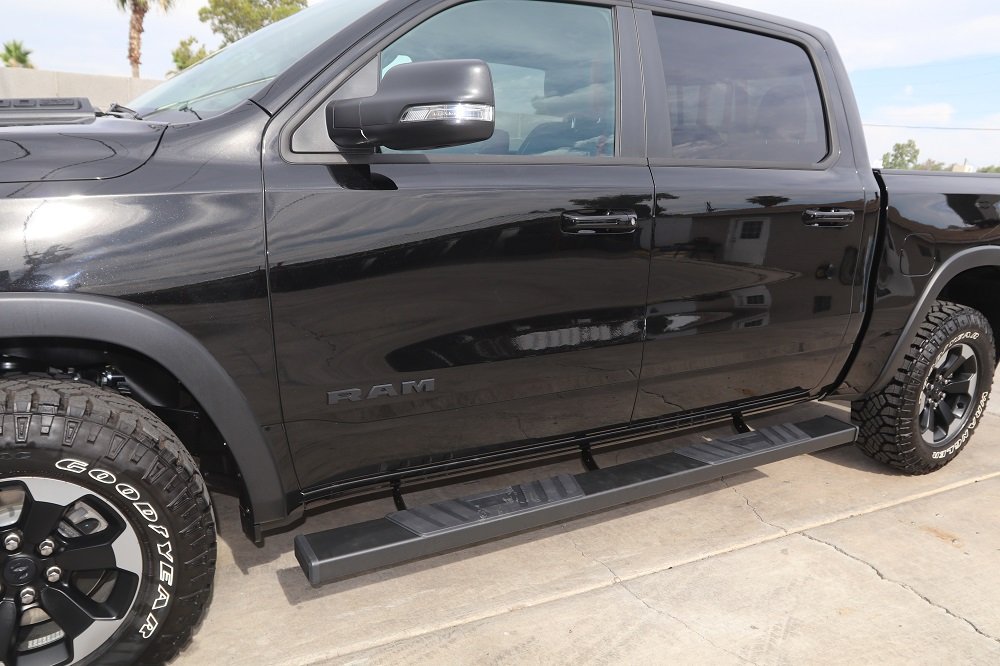
Running boards are flat, wide step platforms that typically run the full length of the cab doors. They provide the largest stepping surface of any side step option and are the closest to what the factory installs on RAM trucks from the factory. The wide surface makes them the most stable option for elderly passengers, children, or anyone carrying cargo while stepping up.
Nerf Bars and Side Steps
Nerf bars use a round or oval tube profile rather than a flat plate surface. They provide a smaller stepping surface than full running boards but offer a cleaner visual profile and more ground clearance. They are a common choice on lifted trucks where the wider running board profile would look visually heavy against the body.
Step Bars and Hoop Steps
Step bars are similar to nerf bars but typically use a larger diameter tube with a distinct step section rather than a continuous surface. Hoop steps extend out from the truck body at the step position and fold back under the body when not in use. Both are popular on work trucks and off-road builds where clearance and a clean look under the body are priorities.
The right choice depends on how the truck is used. A family daily driver benefits most from the wider, more stable surface of a full running board. A work truck or weekend off-road build often fits better with a nerf bar or step bar that provides functional entry without adding width or reducing clearance.
Popular Running Board Options for RAM Trucks
Ram 1500 Running Boards
The RAM 1500 is where running board demand is highest and where the most options exist. Factory OEM Ram 1500 running boards from the current DT generation and the previous DS generation are available in fixed and power-deploying configurations depending on the trim level and option package. Crew Cab Ram 1500 running boards are longer than Quad Cab versions and the two are not interchangeable. Daily driver owners and family trucks benefit most from full-length crew cab running boards. Off-road builds often use shorter side steps or nerf bars to maintain clearance during trail use.
Ram 2500 Running Boards
Work truck running boards on the RAM 2500 need to handle more abuse than a light-duty truck step sees. Crew Cab Ram 2500 running boards are popular on commercial trucks where passengers and workers need reliable step access throughout the workday. The step surface condition matters more on a work truck than on a daily driver because the running board takes constant foot traffic. OEM Ram 2500 side steps sourced from donor trucks in good condition provide the factory fitment accuracy that aftermarket alternatives in this segment sometimes miss on the mounting geometry.
Ram 3500 Running Boards
The RAM 3500 presents additional running board considerations beyond the standard 1500 and 2500. Dually configurations add wheel well width to the rear of the truck that affects how running boards integrate visually with the overall body profile. Crew Cab Ram 3500 running boards for dually trucks need to account for the wider rear stance. Commercial fleet operators often prioritize durability and OEM fitment over styling on 3500 running board replacements.
OEM vs Aftermarket Running Boards
This is the question we hear most often from RAM owners researching running boards and the honest answer is that both have a place depending on what the buyer is trying to accomplish.
OEM Running Boards
Factory OEM Ram running boards are engineered to mount at the factory-specified locations on the truck’s body structure. The bracket positions, mounting hardware, and step surface dimensions are all designed around the specific cab configuration and model year of the truck. When the goal is maintaining factory appearance, replacing a damaged or missing factory step with an OEM unit from the correct cab configuration produces the cleanest result. The OEM step surface texture and finish coordinate with the factory body color in a way that aftermarket alternatives rarely replicate precisely.
The practical limitation of OEM running boards is availability. Factory running board options come off a finite supply of donor vehicles and not every configuration is available at any given time. Lead time on specific configurations can extend a repair timeline.
Aftermarket Running Boards
Aftermarket running boards offer a wider range of styles, materials, and features than factory OEM options. Stainless steel, aluminum, and powder-coated steel options all exist for the major RAM platforms. Some aftermarket running boards include LED step lighting, additional step positions, or wider step surfaces than factory. The tradeoff is that aftermarket mounting hardware quality varies significantly between manufacturers and the mounting bracket positions do not always align precisely with factory body mounting locations without adjustment.
For RAM owners doing a custom build, adding running boards to a truck that did not originally have them, or looking for a specific style not offered in the OEM catalog, aftermarket is the practical path. For a factory-restoration or like-for-like replacement, OEM donor-vehicle running boards are the more accurate solution.
Power Running Boards vs Fixed Running Boards
Power running boards, also called electric running boards, deploy automatically when the door opens and retract under the body when the door closes. Factory power running boards have been available on RAM 1500 trucks in the Sport, Laramie, Rebel, and higher trim levels across the current and previous generation.
The practical advantages are real. The running board deploys to the lowest position automatically when the door opens, maximizing step height reduction without requiring the driver to remember to use it. When retracted, the running board tucks up under the body, improving ground clearance and reducing the visual width of the truck below the door sills.
The maintenance considerations are also real. Power running boards use an electric motor and linkage mechanism that adds mechanical complexity beyond a fixed bracket system. The motor and linkage are exposed to road spray, mud, and weather. Failures are not common on well-maintained trucks but they do occur on high-mileage examples and trucks that operate in consistently wet or muddy conditions. Replacing a failed power running board system is a more involved repair than replacing a fixed running board bracket.
For daily drivers and family trucks the power deployment is a genuine quality-of-life improvement. For work trucks and off-road builds that accumulate exposure to mud, water, and debris, fixed running boards are often the more reliable long-term choice.
How to Choose the Correct Running Boards for Your RAM
Getting running board fitment right requires confirming several specific details before ordering.
Model Year and Generation
RAM 1500 running board mounting locations changed between the DS generation (2009–2018) and the current DT generation (2019–present). A running board designed for a DS Ram 1500 does not mount correctly on a DT truck. Generation confirmation is the starting point for any running board purchase.
Cab Configuration
Crew Cab and Quad Cab running boards use different lengths because the door sill lengths differ between the two cab configurations. Ordering a Crew Cab running board for a Quad Cab truck results in a board that extends beyond the door opening on one end. This is the most common running board fitment mistake we see.
Bed Length
Running board length is typically tied to cab configuration rather than bed length on most RAM trucks, but confirming this for your specific year and model prevents ordering errors on trucks with unusual configurations.
Trim Level and Factory Options
Factory power running board provisions are tied to specific trim levels and option packages. Confirming whether your truck was factory-equipped with power running boards or fixed steps affects which replacement type integrates correctly with existing body wiring and bracket positions.
Common Mistakes Buyers Make
Ordering the wrong cab length. Crew Cab and Quad Cab running boards are not the same length. Confirm your cab configuration before ordering every time.
Ignoring the generation. DS and DT Ram 1500 mounting locations differ. A running board that fits a 2016 Ram 1500 does not necessarily fit a 2021 Ram 1500 at the factory mounting points.
Assuming all trims use the same bracket. Factory bracket positions vary between trim levels in some configurations. Confirm the trim level of the donor running board against your truck.
Not verifying power versus fixed compatibility. Replacing a power running board system with a fixed unit requires addressing the wiring provisions at the body mounting location. Confirm which type your truck uses before ordering a replacement.
Purchasing without condition photos. Running boards on donor vehicles accumulate surface wear, bracket rust, and step surface damage. Always request photos of the bracket condition and step surface before committing to a used OEM set.
Questions RAM Owners Ask About Running Boards
Are OEM running boards worth it over aftermarket? For factory-restoration and like-for-like replacement projects, OEM running boards from the correct donor configuration provide the most accurate fitment and finish match. For custom builds or trucks that never had factory running boards, aftermarket options offer more flexibility.
Will running boards fit all RAM trucks? No. Running boards are specific to cab configuration, model year generation, and in some cases trim level. Confirming all three before ordering is essential.
Do running boards affect ground clearance? Fixed running boards reduce ground clearance at the lowest point of the step surface. Power running boards retract under the body and maintain full clearance when deployed. For trucks used in off-road applications, this distinction matters.
Can factory running boards be reused after body repairs? In most cases yes, provided the bracket mounting points are undamaged and the step surface is in acceptable condition. Inspect the bracket hardware and mounting tabs before reinstalling running boards after any front-end or body repair.
Are power running boards reliable long-term? Factory power running board systems on RAM trucks are generally reliable on well-maintained trucks. High-mileage examples and trucks with heavy mud and water exposure experience higher failure rates. Budget for eventual motor or linkage service on power-equipped trucks with significant mileage.
Buyer Checklist Before Ordering RAM Running Boards
Before placing any running board order, confirm the following:
- Model year confirmed
- Generation confirmed (DS 2009–2018 or DT 2019–present for Ram 1500)
- Cab configuration confirmed (Crew Cab or Quad Cab)
- Trim level confirmed
- Power or fixed confirmed
- Bracket condition verified through photos
- Step surface condition verified through photos
- Mounting hardware included confirmed
Related OEM RAM Exterior Parts
Running boards are often part of a broader exterior restoration or upgrade project. RAM owners sourcing running boards frequently need related exterior components at the same time. OEM front bumpers, rear bumpers, fender flares, grille assemblies, tow mirrors, and bed steps all come off the same donor vehicles that provide running boards. If your truck needs multiple exterior components, confirming availability across related parts at the same time simplifies the sourcing process and reduces shipping costs.
When you are ready to explore what is currently available, our RAM Truck Running Boards inventory covers OEM fixed and power running board options across Ram 1500, Ram 2500, and Ram 3500 configurations. Availability changes as donor vehicles come through our Cleveland facility so confirming current stock before your project timeline closes is the practical approach.
Final Thoughts
Running boards are a practical, high-impact addition to any RAM truck and one of the most common replacement parts we handle at McClain Auto Part. Getting the fitment right before ordering saves time, return shipping cost, and project delays. Confirm your model year, generation, cab configuration, and trim level before reaching out. Request condition photos on any used OEM set before committing.
The difference between a running board that installs cleanly in an afternoon and one that requires bracket modification and adjustment work almost always comes down to whether the buyer verified these details before the order shipped. Do the verification first and the rest of the process takes care of itself.
