Uncategorized
Hellcat Engine for Sale: What to Know Before Buying a Used Engine
Aug
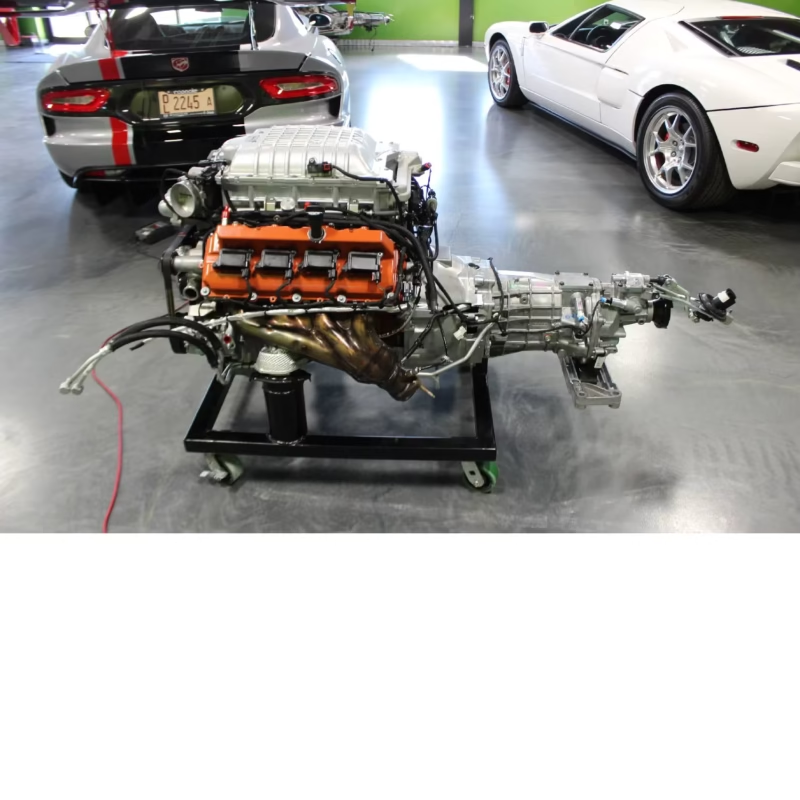
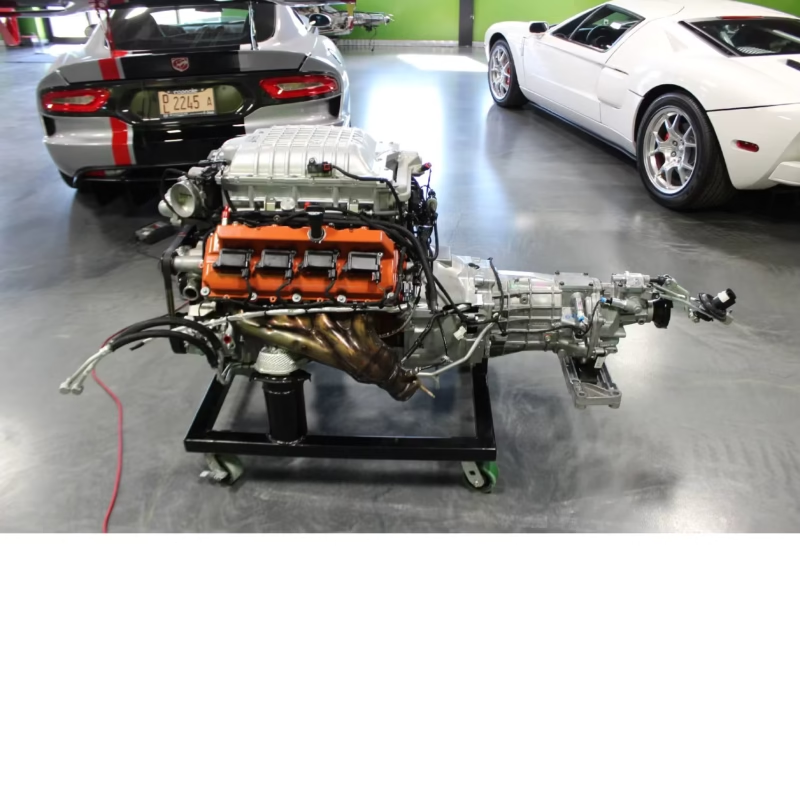
If you are looking for a Hellcat engine for sale, you already know this is not a small purchase. A used 6.2L supercharged HEMI is a significant investment, and the wrong decision can cost you far more than the engine itself. The wrong variant, undisclosed mileage, a missed inspection point, or a compatibility issue between the engine and your vehicle can turn a good deal into an expensive problem fast.
This guide covers what to inspect, which variant matters for your application, what questions to ask the seller, and how to avoid the most common mistakes buyers make on this platform.
What Is a Hellcat Engine
The Hellcat engine is a 6.2L supercharged V8 built by Chrysler on the HEMI platform. Dodge introduced it in 2015 in the Challenger SRT Hellcat and Charger SRT Hellcat, producing 707 horsepower from the factory. That output figure made it one of the most powerful production car engines available at the time, and it still holds up as a serious power unit today.
The engine uses an IHI positive displacement supercharger mounted on top of the intake manifold, forcing compressed air into the combustion chambers under pressure. That forced induction is why the output is so far above what a naturally aspirated 6.2L V8 would produce on its own. The block is cast iron for durability under sustained high output. The cylinder heads are aluminum.
For anyone doing a replacement or a swap project, the Hellcat is appealing because it delivers real supercharged V8 output in a package that came from the factory with the engineering and supporting systems already designed around it, not just a bolt-on kit retrofitted to an engine that was not built for forced induction.
Which Vehicles Use the 6.2L Hellcat Engine
The 6.2L supercharged HEMI appeared in several factory applications across the Dodge, Ram, and Jeep lineups.
Challenger SRT Hellcat — 2015 to 2023, standard 707 horsepower
Charger SRT Hellcat — 2015 to 2023, standard 707 horsepower
Challenger SRT Hellcat Redeye — 2019 to 2023, 797 horsepower
Charger SRT Hellcat Redeye — 2021 to 2023, 797 horsepower
Challenger SRT Super Stock — 2020 to 2023, 807 horsepower
Durango SRT Hellcat — 2021, 710 horsepower
Ram 1500 TRX — 2021 to 2024, 702 horsepower, truck-specific calibration
Each of these applications uses a version of the 6.2L supercharged platform. They are not all the same engine configuration, and understanding that distinction is one of the most important points in this guide.
Are All Used Hellcat Engines the Same
No. This is where buyers make the most common and most costly mistakes.
The standard Hellcat, the Redeye, the Super Stock, and the TRX all use a 6.2L supercharged V8, but they differ in meaningful ways. Supercharger setup, piston specification, fuel system configuration, calibration, and engine management can all vary between applications. Treating them as interchangeable creates compatibility problems and can result in an engine that does not match what your vehicle or build actually requires.
What to Check Before Buying a Used Hellcat Engine
A used 6.2L supercharged HEMI that has been properly inspected and documented is a solid purchase. One that has not been inspected carries risk that is difficult to account for after the sale. Here is what matters and why.
Verify the Donor Vehicle and VIN
The most important piece of information on any used Hellcat engine is where it came from. Knowing the donor vehicle tells you almost everything else you need to evaluate the purchase.
A reputable seller provides the donor VIN. That VIN lets you verify the vehicle year, the specific Hellcat configuration, the trim level, and in many cases the vehicle history. An engine pulled from a low-mileage vehicle that sustained front-end collision damage is a very different purchase from one that came out of a flood or fire total. The donor VIN is how you tell the difference.
If a seller cannot provide donor vehicle documentation, that absence is itself useful information.
Check the Documented Mileage
Mileage on a used Hellcat engine should come from donor vehicle records, not from a seller’s estimate. A documented mileage figure tied to the donor VIN is verifiable. A verbal claim with no supporting documentation is not worth treating as fact.
The Hellcat handles mileage reasonably well when maintained correctly, but rod bearing condition becomes a real consideration on engines that have seen track use or aggressive driving, regardless of the odometer reading. Low documented mileage from a verifiable source is worth paying a premium for on this platform, particularly if the donor vehicle history suggests conservative use.
Ask for Compression Test Results
Compression testing is the most direct way to assess internal engine condition without disassembly. A healthy Hellcat should show consistent compression readings across all eight cylinders. A significant drop on one or more cylinders points to internal wear, a leaking valve, or a head gasket issue that will not resolve itself after installation.
Ask for the actual numbers, not just confirmation that a test was performed. A seller who compression tests their engines records the results and can produce them on request. If the seller confirms testing but cannot provide specific readings, the test is difficult to evaluate and may not have happened the way it was described.
Check for Oil and Coolant Leaks
External leaks are among the first things to assess on a used Hellcat. Common leak points on this platform include the valve cover gaskets, the front main seal, the rear main seal, and the supercharger inlet connections.
Oil contamination in the coolant or coolant contamination in the oil is a serious red flag. Either condition points to a head gasket failure or a cracked head, both of which require significant repair before the engine is usable. Ask the seller specifically how the inspection addressed oil and coolant condition on the unit you are considering.
Inspect the Supercharger and Accessories
The supercharger is one of the most valuable and most critical components on a used Hellcat engine. Shaft play on the supercharger indicates bearing wear. A worn supercharger bearing produces noise under boost and can fail without much warning if the wear is advanced enough.
Check the supercharger inlet for any evidence of debris ingestion. Even small amounts of foreign material through the inlet can damage the rotor pack. Ask what the supercharger inspection specifically covered and what condition the unit is in. Confirm what accessories come with the engine and what condition each component is in before the sale is finalized.
Standard Hellcat vs Redeye vs Super Stock vs TRX
This is the single most important section for anyone sourcing a used Hellcat engine for a replacement or swap application.
Standard Hellcat — 707 Horsepower
The original configuration, launched in 2015. It uses cast aluminum pistons and produces approximately 11.6 psi of boost through the standard IHI supercharger pulley ratio. This is the most commonly available used Hellcat engine in the market because of its long production window and high production volume across Challenger and Charger applications. For a direct replacement in a standard Hellcat-equipped vehicle, this is the correct unit to source.
Redeye — 797 Horsepower
Introduced for the 2019 model year in the Challenger and 2021 in the Charger. The Redeye adds a larger supercharger inlet, a revised pulley ratio producing approximately 14.5 psi of boost, and forged aluminum pistons in place of the cast units used in the standard Hellcat. Those forged pistons represent a meaningful durability improvement under sustained high-boost operation.
The Redeye supercharger inlet and the standard Hellcat inlet are not interchangeable without addressing intake manifold and ECU calibration differences. If your vehicle was built as a Redeye, source a Redeye unit rather than assuming a standard Hellcat engine covers the application.
Super Stock — 807 Horsepower
The highest factory output configuration of the Hellcat platform, appearing in the Challenger SRT Super Stock from 2020. The Super Stock uses the Redeye supercharger with additional calibration changes. Replacement applications for this variant require matching the complete engine management system, not just the block.
Ram 1500 TRX — 702 Horsepower
The TRX brought the 6.2L supercharged HEMI to the truck segment for 2021. The TRX engine carries truck-specific calibration, a different accessory drive configuration, and different mounting provisions from the car-based applications. Cross-platform use between TRX and car-based Hellcat applications requires engineering consideration beyond a simple component exchange. Do not assume a TRX engine installs into a Challenger or Charger without addressing these differences.
| Configuration | Horsepower | Torque | Boost | Pistons |
|---|---|---|---|---|
| Standard Hellcat | 707 hp | 650 lb-ft | ~11.6 psi | Cast aluminum |
| Redeye | 797 hp | 707 lb-ft | ~14.5 psi | Forged aluminum |
| Super Stock | 807 hp | 707 lb-ft | ~14.5 psi | Forged aluminum |
| TRX | 702 hp | 650 lb-ft | ~11.6 psi | Cast aluminum |
Used Hellcat Engine vs Crate Engine
This comparison comes up regularly and the honest answer depends on your budget and your priorities.
A new crate engine from a licensed supplier gives you a fresh unit with a full manufacturer warranty. That peace of mind is real. The trade-off is price. A new supercharged crate engine at this output level costs significantly more than a verified low-mileage used OEM unit.
A used OEM Hellcat engine from a verified low-mileage donor vehicle with documented compression testing and a thorough inspection covers similar functional ground at a lower cost. You are accepting some mileage and some donor vehicle history, but a thorough inspection addresses the meaningful risks that mileage introduces.
For a factory replacement where the goal is returning the vehicle to stock performance, a verified used OEM unit is often the practical choice. For a custom build where the engine will see additional modifications, a used OEM engine provides a cost-effective foundation before that work begins.
Will a Used Hellcat Engine Fit My Vehicle
For a direct replacement in the same vehicle the engine came out of, fitment is straightforward provided you match the correct variant. The mounting, accessory drive, and ECU are already configured for the application.
For a swap into a different vehicle, the complexity increases. Whether a Hellcat engine will work in a non-factory application depends on several factors that each need to be addressed before the engine arrives.
Transmission bellhousing — Factory Hellcat pairings are the TorqueFlite 8HP90 eight-speed automatic and the Tremec TR-6060 six-speed manual. Confirm your transmission is compatible with the bellhousing bolt pattern before ordering.
Fuel system — The Hellcat runs a high-pressure returnless fuel system. The pump, lines, and injectors need to be compatible with the engine’s fuel delivery requirements.
ECU solution — The factory PCM is VIN-locked to the original vehicle. For swap applications, a standalone engine management solution or a compatible PCM from the same donor vehicle is required. Plan this before the engine arrives, not after.
Motor mounts — Factory mounts work in factory applications. Swap applications typically require fabricated or aftermarket motor mounts matched to the target chassis.
Cooling system — The Hellcat runs two separate cooling circuits. The main circuit handles the engine. A separate circuit handles the supercharger intercooler. Both need to be properly routed and sized in a swap application.
None of these are unusual challenges for an experienced builder, but all of them require planning before the engine arrives.
What Comes With a Used Hellcat Engine
What is included in a used Hellcat engine listing varies significantly between sellers. Before any purchase, confirm in writing exactly what the package includes.
Typically included on most listings:
Complete long block assembly including block, heads, valvetrain, and timing components
Supercharger assembly
Intake manifold
Fuel rails and injectors
Valve covers and oil pan
Front cover and timing cover
Engine sensors as equipped on the donor vehicle
Often available separately or by request:
Engine wiring harness
PCM or ECU
Accessory drive components including alternator and air conditioning compressor
Oil cooler
Exhaust manifolds
Ask before you assume. A listing that says engine for sale may mean the long block only. Confirm the specific component list for the unit you are buying before committing to the purchase.
What Warranty Should You Expect With a Used Hellcat Engine
A 6-month warranty against internal mechanical defects is a reasonable expectation from a reputable used engine seller. That warranty should cover failures that result from defects present at the time of sale, not from installation errors, insufficient fuel octane causing detonation, or cooling system issues from improper installation.
Read the warranty terms before you commit. Understand what is covered, what is excluded, and what the claim process looks like. A seller who explains their warranty clearly before the sale is a more reliable indicator of post-sale support than one who only references it in general terms.
At McClain Auto Part, every engine we sell comes with a 6-month warranty against internal mechanical defects. If a covered issue comes up, contact us directly and we work toward a fair resolution.
How Much Does a Used Hellcat Engine Cost
Used Hellcat engine pricing varies based on mileage, variant, included components, and current market availability. Several factors consistently push the price higher.
Lower documented mileage from a verifiable source commands a premium because it represents lower risk. The Redeye and Super Stock variants carry higher prices than the standard configuration due to the forged pistons and higher output. A more complete package that includes the supercharger, harness, and accessories is worth more than a bare long block that requires additional sourcing before installation.
As a general reference, a used OEM Hellcat engine sits meaningfully below the cost of a new crate engine at equivalent output levels. Contact the seller directly for current pricing on the specific unit in their inventory. Ask for the mileage, included components, inspection documentation, and warranty terms before comparing prices between sellers.
Used Hellcat Engine Buying Checklist
Before committing to any used Hellcat engine purchase, work through this list.
Donor vehicle confirmed with VIN documentation
Mileage verified from donor vehicle records, not estimated
Compression test completed with actual numbers recorded and available
Oil inspected for metal contamination
Coolant passages inspected for oil contamination
Supercharger inspected for shaft play and housing condition
Supercharger inlet inspected for debris ingestion evidence
External leaks confirmed absent at all gasket and seal surfaces
Variant confirmed as matching your application requirements
Component list confirmed in writing before purchase
Warranty terms reviewed and understood before purchase
Transmission compatibility confirmed for your application
ECU solution planned before the engine arrives
Fuel system compatibility confirmed for your application
Both cooling circuits confirmed for swap applications
Frequently Asked Questions About Used Hellcat Engines
What is the difference between a standard Hellcat and a Redeye engine
The standard Hellcat produces 707 horsepower with cast aluminum pistons and approximately 11.6 psi of boost. The Redeye produces 797 horsepower with forged aluminum pistons and approximately 14.5 psi of boost from a revised supercharger inlet and pulley ratio. The two are not directly interchangeable without addressing fuel system and calibration differences.
Can I put a Hellcat engine in any vehicle
The Hellcat can work in many applications beyond its factory chassis, but it is not a simple drop-in outside of factory applications. You need to address the transmission bellhousing, fuel system, ECU, motor mounts, and both cooling circuits before the engine will operate correctly. Whether it makes sense for your specific build depends on those factors and your build plan.
How many miles is too many on a used Hellcat engine
There is no universal mileage cutoff. Documented mileage from a verifiable source matters more than the number itself. A verified 60,000-mile unit from a well-maintained donor vehicle is a better purchase than an unverified 30,000-mile claim with no documentation. Ask for the donor VIN and verify.
Does a used Hellcat engine include the supercharger
It depends on the specific listing. Confirm what is included before purchase. Do not assume the supercharger is part of the package without asking directly.
What transmission works with a Hellcat engine
Factory pairings are the TorqueFlite 8HP90 eight-speed automatic and the Tremec TR-6060 six-speed manual. For swap applications, confirm bellhousing compatibility and the correct flexplate or flywheel specification for your chosen transmission before ordering the engine.
Why does the PCM matter on a used Hellcat engine
The factory PCM is VIN-locked to the original vehicle. For a direct replacement in the same car, your existing PCM is typically reused with a reflash to recognize the replacement engine. For swap applications, a standalone engine management solution is the most common approach. Plan this before installation begins, not after the engine arrives.
Is rod bearing replacement recommended on a used Hellcat
Many experienced Hellcat installers recommend replacing rod bearings at installation regardless of mileage, particularly on engines from donor vehicles with track use or aggressive driving history. ACL and Mahle produce rod bearings in the correct Hellcat specification. Treating rod bearing replacement as a precautionary service item at installation eliminates one of the platform’s primary long-term risk factors.
Final Advice Before Buying a Used Hellcat Engine
A used Hellcat engine is a legitimate and cost-effective path to factory supercharged V8 performance when the purchase is handled correctly. The platform is capable, the aftermarket support is strong, and verified low-mileage units are available in the used market.
The mistakes that turn a good deal into an expensive one are almost always avoidable. Buying from a seller who cannot produce donor vehicle documentation, accepting mileage claims without verification, skipping the compression test conversation, and assuming variants are interchangeable are the decisions that cause the most problems.
Before you buy one, find out where the engine came from and how the mileage was documented. A low-mileage engine with no paperwork is not the same thing as a low-mileage engine with donor records. That distinction is worth understanding before you commit to a purchase at this price point.
At McClain Auto Part, we have been shipping used OEM engines out of Cleveland, Ohio since 2009. We have shipped over 10,000 engines to mechanics, shops, and builders across all 50 states and carry a 4.9 out of 5 rating across 800 or more verified Google reviews. Every Hellcat engine we sell goes through compression testing, supercharger inspection, oil condition assessment, and mileage verification from donor vehicle records before it ships. Each unit comes with a 6-month warranty against internal mechanical defects.
If you are looking for a used Hellcat engine for sale, send us your VIN and vehicle information. We confirm the available engine variant, mileage, included components, compatibility, and warranty before you commit to anything.
Call us at +1(216) 230-5433 or email sales@mcclainautopart.com.
