Uncategorized
How Much Does a Hellcat Engine Cost? Real-World Pricing Guide
Jul
There is no single answer to how much a Hellcat engine price, and that is exactly why buyers end up How Much Does a Hellcat Engine Cost? Real-World Pricing Guide
There is no single answer to how much a Hellcat engine costs, and that is exactly why buyers end up confused when comparing listings. At McClain Auto Part, a verified low-mileage complete 6.2L Hellcat engine is priced at $8,000. That price reflects a documented, inspected, warrantied engine ready to ship from our Cleveland, Ohio warehouse. Other sellers may advertise lower prices, but what is actually included, how the mileage was verified, and whether any warranty exists can differ significantly from listing to listing.
Two engines can both say 6.2L Hellcat engine for sale and be thousands of dollars apart. Understanding what drives that gap is what lets you compare listings accurately rather than just comparing numbers.
How Much Does a Hellcat Engine Usually Cost
At McClain Auto Part, a verified low-mileage complete Hellcat engine is $8,000. The table below gives a general market framework across engine types to help put that figure in context. Treat the ranges as approximate starting points rather than fixed prices. Actual figures change based on mileage, condition, availability, included components, seller, and shipping costs.
| Hellcat Engine Type | Approximate Price Range | What Typically Comes With It | Key Pricing Factors |
|---|---|---|---|
| Used long block only | Lower end of market | Block, heads, valvetrain, timing | Mileage, condition, no supercharger |
| Used complete engine | Mid range | Long block plus supercharger and accessories | Mileage, documentation, component list |
| Low mileage verified complete | Mid to upper range | Full assembly, documented history | Donor records, inspection, warranty |
| Rebuilt or remanufactured | Varies widely | Depends on builder and scope | Build quality, components, warranty |
| New OEM or crate engine | Upper range | Factory specification, consistent build | New condition, manufacturer warranty |
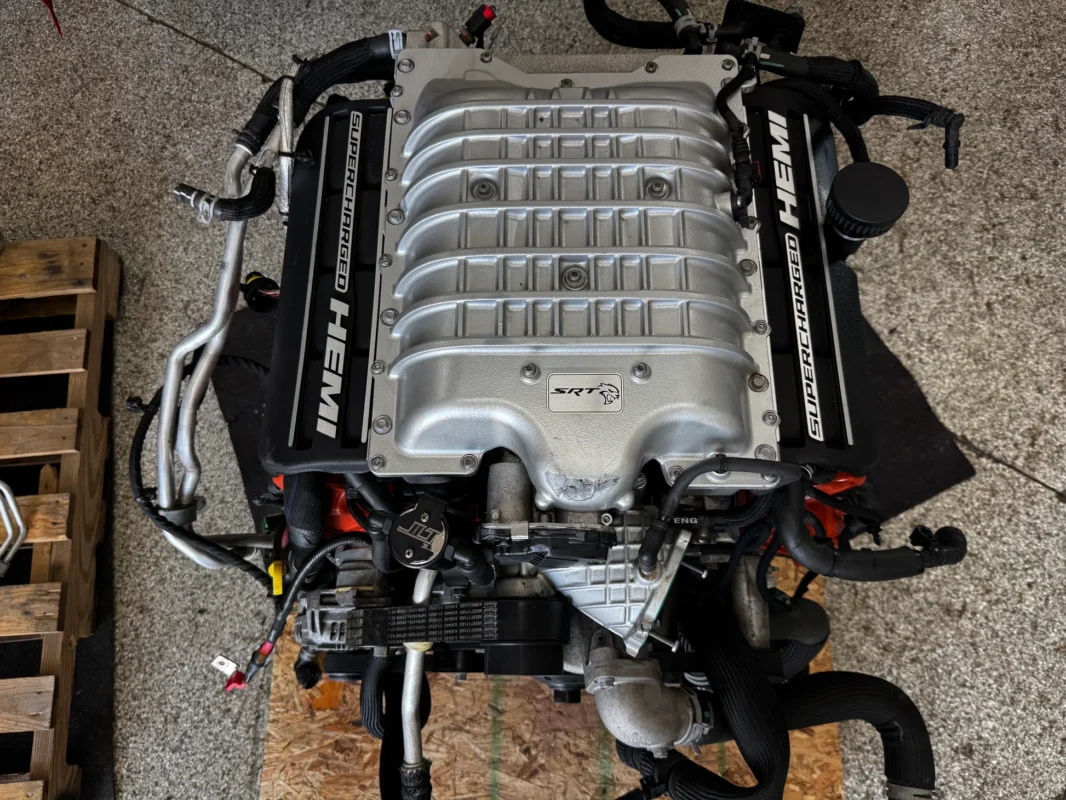
The price difference between a bare long block and a complete engine with the supercharger can be substantial on the Hellcat platform. The IHI supercharger is one of the most expensive individual components on this engine. A listing that includes it is worth considerably more than one that does not, even when the advertised prices look similar at first glance.
What Makes One Hellcat Engine More Expensive Than Another
| Pricing Factor | How It Affects Value |
|---|---|
| Verified mileage | Documented mileage commands a premium over unverified claims |
| Engine condition | Compression results and inspection documentation add confidence |
| Long block vs complete | Complete engines cost more because more components are included |
| Supercharger included | Major value difference on the Hellcat platform specifically |
| Accessories and sensors | Throttle body, injectors, fuel rails, and sensors add to total value |
| Donor vehicle history | Known source reduces risk and supports the mileage claim |
| Testing documentation | Compression results, oil condition, and inspection records |
| Warranty | A 6-month warranty against mechanical defects has real monetary value |
| Configuration | Redeye and Super Stock variants command more than standard Hellcat |
| Availability | Limited supply on specific configurations affects market pricing |
| Shipping | Freight costs on a palletized engine add to total purchase cost |
Used Hellcat Engine Prices: What Are You Really Paying For
When you buy a used 6.2L Hellcat engine, you are paying for two things: the physical engine and the documentation behind it. Both matter, and the absence of documentation is itself a signal about the seller’s confidence in what they are selling.
Depending on the seller’s inspection process, buyers may be able to obtain some or all of the following before committing to a purchase:
- Verified mileage from donor vehicle records rather than a verbal estimate
- The donor vehicle source and what happened to it
- Compression test results from each cylinder
- An oil condition assessment for metal contamination or bearing distress indicators
- A supercharger inspection covering shaft play and housing condition
- A written list of exactly which components are included
- Warranty terms in writing
- Photos of the actual engine being sold
A lower-priced engine with unknown mileage and no inspection documentation may look attractive at first glance. A higher-priced engine with verified mileage, clean compression numbers, documented oil condition, and a warranty may deliver significantly better value once you factor in the risk you are absorbing with the cheaper option. The lowest listed price is rarely the lowest total cost.
New and Crate Hellcat Engines: Why They Cost More
A new or crate engine commands a premium for straightforward reasons. The mileage is zero. The history is known. The specification is consistent. Warranty coverage starts from day one rather than covering an unknown prior life.
For a factory replacement where budget is less of a concern than certainty, a new engine makes sense. For a project build where cost is a real constraint, a verified used engine from a reputable seller with transparent documentation can be a more practical path at meaningfully lower cost.
One thing worth noting is that not all crate engines include the same components. A crate long block is a different purchase from a complete crate engine. Confirm exactly what is included in any crate listing the same way you would with a used engine. The advertised price alone does not tell you what you are actually getting.
The Difference Between a Hellcat Long Block and a Complete Engine
This distinction causes more pricing confusion than almost anything else in the used engine market, and it is worth understanding before comparing any two listings.
A long block typically includes the engine block, cylinder heads, valvetrain, camshaft, and timing components. Depending on the seller and how the engine was pulled, it may also include the oil pan and valve covers. What a long block typically does not include is the supercharger, intake manifold, fuel rails, injectors, throttle body, sensors, wiring, or accessory drive components.
A complete engine includes those additional components, though the exact list varies by listing and donor vehicle condition.
On the Hellcat platform, this distinction is especially significant because the supercharger represents a large portion of the engine’s total value. A lower-priced listing may be for a long block only, while a higher-priced listing includes the supercharger, intake, fuel system components, and sensors. These are not comparable purchases at face value.
Before comparing any two Hellcat engine prices, request a written component list from each seller. A long block that requires you to source a supercharger separately may end up costing more in total than a complete engine at a higher advertised price. Always ask before assuming.
Does Mileage Affect Hellcat Engine Price
Yes, but mileage should not be the only thing you evaluate. It is one data point, not the complete picture.
Lower documented mileage from a verifiable source typically commands a higher price because it represents less accumulated wear. However, mileage without context has limited value. An engine with 45,000 miles from a car that was tracked regularly and serviced inconsistently may have more bearing wear than one with 70,000 miles from a daily driver with consistent oil changes and no track use.
This is why documented mileage from donor vehicle records matters more than a seller’s stated estimate, and why inspection documentation matters alongside whatever mileage figure is provided. A well-documented engine with clean compression numbers often represents a better purchase than a lower-mileage claim with no supporting documentation.
How Much Does a Hellcat Engine Swap Actually Cost
The engine purchase is typically the most visible line item in a Hellcat swap budget, but it is rarely the total cost. Swap costs vary dramatically depending on the target vehicle, how complete the donor engine package is, and who does the work.
Components that commonly add to the engine cost in a swap application include:
- Transmission — Bellhousing compatibility must be confirmed for your specific transmission
- Engine mounts — Swap applications typically require aftermarket or fabricated motor mounts
- ECU and wiring — The factory PCM is VIN-locked, so swap applications require a standalone solution or compatible PCM along with wiring harness work
- Fuel system — The target vehicle’s fuel system must support the Hellcat’s requirements, and swap-specific modifications may be necessary
- Cooling — The Hellcat runs separate cooling circuits for the engine and supercharger intercooler, both of which need proper routing in a swap
- Exhaust — Headers and routing are chassis-specific and typically require sourcing or fabrication
- Labor and tuning — Professional installation and a post-installation tune are important for correct and reliable operation
- Miscellaneous — Hardware, fluids, brackets, and small components add up across any engine installation
As a hypothetical example: if the engine represents $8,000 of your budget, plan for the supporting systems to add meaningfully to that figure. The actual total depends on the target vehicle, how complete the donor package is, and local labor rates. There is no universal Hellcat swap cost that applies across all applications.
Before You Buy a Hellcat Engine, Ask These Questions
A reputable seller should be able to answer all of these before the sale is finalized.
- What exact Hellcat configuration is this? Standard, Redeye, Super Stock, and TRX are different engines. Confirm which one you are buying.
- What is the documented mileage and how was it verified? Donor vehicle records are more reliable than verbal estimates.
- What vehicle did the engine come from? The donor source tells you about the engine’s use history.
- Has the engine been compression tested? This is the most direct assessment of internal condition without disassembly.
- Can you provide the actual compression results? Confirmation of testing without numbers is difficult to evaluate.
- Is the supercharger included? This is a critical distinction on the Hellcat platform.
- Is this a long block or a complete engine? Ask for a written component list.
- What accessories are included? Throttle body, injectors, sensors, and other components affect total value.
- What does the warranty cover? Understand the term length and what is explicitly included.
- What is excluded from the warranty? Understand what falls outside coverage before you commit.
- Are photos of the actual engine available? Photos confirm the physical condition and components present.
- How is the engine packaged and shipped? A palletized and secured engine is less likely to arrive damaged.
Questions 1 and 6 matter most for compatibility. Questions 4 and 5 matter most for condition confidence. Questions 9 and 10 matter most for post-purchase risk.
How to Compare Two Hellcat Engine Listings
Lower advertised price does not automatically mean better value. Here is a practical example showing why.
Engine A:
- Lower asking price
- Mileage unknown or unverified
- No inspection documentation
- Long block only, supercharger not included
- No warranty
Engine B:
- $8,000
- Mileage verified from donor vehicle records
- Compression test results available
- Complete engine, supercharger included
- 6-month warranty against internal mechanical defects
Engine A may look attractive based on the number alone. But once you factor in the cost of sourcing a supercharger separately, the risk of unknown condition, and the absence of warranty coverage, the actual total cost and risk of Engine A may be higher than Engine B despite the lower advertised price.
Engine B may represent better total value depending on your situation, budget, and risk tolerance. The comparison exercise is not about finding the lowest price. It is about finding the best total value for your specific application.
Is a Used Hellcat Engine Worth Buying
It can be, when purchased carefully. It can also be a frustrating experience when purchased on price alone.
When a used engine can make sense:
- Lower purchase cost compared to new or crate
- Factory OEM components and specification
- Verified mileage from a documented source
- Inspection documentation available
- Warranty provided
- Replacement or project application where new engine cost is prohibitive
Potential concerns to evaluate:
- Unknown maintenance history on undocumented engines
- Missing components requiring additional sourcing
- No warranty or unclear warranty terms
- Possibility of prior track use or aggressive driving history
- Storage-related issues on engines that have sat for extended periods
- Additional parts required for your specific application
A used engine with solid documentation, clean inspection results, and a warranty from a seller who has been in business long enough to stand behind their product is a very different purchase from an undocumented engine at a lower price. Both are used engines. They represent very different levels of confidence and risk.
Hellcat Engine Cost FAQ
How much does a 6.2L Hellcat engine cost?
At McClain Auto Part, a verified low-mileage complete Hellcat engine is priced at $8,000. Across the broader market, prices vary based on whether the engine is used or new, what is included, mileage, condition, and the seller. No single price applies across all listings.
Are used Hellcat engines cheaper than new ones?
Generally yes. A verified low-mileage used engine with documentation and warranty costs less than a new crate engine. An undocumented used engine without a warranty costs less still, but carries higher risk. The price difference between used and new reflects the documentation, condition certainty, and warranty coverage that come with a new engine.
How much does a Hellcat crate engine cost?
New or professionally built crate engines at Hellcat output levels carry a premium above the used market. Exact pricing depends on the supplier, what is included, and the specific configuration. Always confirm what the crate package includes before comparing prices.
Does mileage affect the Hellcat engine price?
Yes, but mileage without documentation has limited value. Verified low mileage from donor records typically commands a premium. Inspection documentation and maintenance history provide important context alongside the mileage figure.
What is included with a Hellcat engine?
It depends entirely on the listing. A long block typically does not include the supercharger or accessories. A complete engine typically does. Always request a written component list before comparing prices or making a purchase decision.
How much does a Hellcat engine swap cost?
The engine is one part of the total swap budget. Transmission compatibility, motor mounts, ECU and wiring, fuel system, cooling, exhaust, labor, and tuning all add to the total. Swap costs vary widely by target vehicle and how complete the donor engine package is.
Is a used Hellcat engine worth buying?
It can be when the engine is properly documented, inspected, and backed by a warranty. An undocumented engine at a low price carries risks that are difficult to evaluate before purchase. The answer depends on the specific engine being offered and how much information the seller can provide.
What should I check before buying a Hellcat engine?
Exact configuration, documented mileage, donor vehicle source, compression test results, supercharger condition, included components, warranty terms, seller reputation, and shipping arrangements. Getting a written component list and warranty terms before purchasing is essential.
Does the supercharger come with the engine?
Not always. Confirm specifically whether the supercharger is included before comparing prices. On the Hellcat platform, this is a significant portion of the engine’s total value and a critical compatibility component.
What is the difference between a Hellcat long block and a complete engine?
A long block is the core internal assembly and typically does not include the supercharger, fuel system components, sensors, or accessories. A complete engine includes those components, with the exact list varying by listing. A lower advertised price may indicate a long block only, which changes the true total cost of the purchase significantly.
Final Buying Advice
The cheapest Hellcat engine is rarely the best deal once you account for everything the price does not include. Missing components, absent documentation, and no warranty coverage can turn a lower upfront cost into a higher total project cost.
Before committing to any purchase, compare mileage documentation, inspection records, included components, warranty coverage, and total project cost rather than advertised price alone. Two engines at different price points may represent similar actual costs once everything is factored in, or the higher-priced engine may represent meaningfully better value.
At McClain Auto Part, verified low-mileage complete Hellcat engines are priced at $8,000. That price includes a documented, inspected engine with mileage verified from donor vehicle records, compression test results available before the sale is finalized, a 6-month warranty against internal mechanical defects, and freight shipping from our Cleveland, Ohio warehouse. We have been sourcing and selling used OEM engines since 2009 and have shipped over 10,000 engines to mechanics, shops, and builders across all 50 states. We carry a 4.9 out of 5 rating across 800 or more verified Google reviews.
When you reach out, have your VIN, vehicle year, make and model, desired configuration, and whether you need a long block or complete engine ready. That information lets us confirm the correct variant, check current availability, and answer your questions accurately before you commit to anything.
Call us at +1(216) 230-5433 or email sales@mcclainautopart.com.
