Uncategorized
Hellcat Engine VIN and Casting Number Guide: How to Identify a Genuine 6.2L Supercharged HEMI
Aug
If you are buying a used Hellcat engine for sale, verifying one for insurance or documentation purposes, or trying to confirm whether the engine in a vehicle matches the original build sheet, you need to know how to read the identification numbers. A Hellcat engine with no documentation is a different purchase from one where the casting numbers, VIN tag, and donor vehicle history all tell the same story.
This guide covers how the 6.2L supercharged HEMI is identified, where to find the relevant numbers, what those numbers mean, and how to use them to confirm you have the right engine before you commit to a purchase or an installation.
Why Engine Identification Matters on the Hellcat Platform
The Hellcat platform spans multiple variants with meaningful differences in piston specification, supercharger configuration, output, and engine management requirements. The standard Hellcat at 707 horsepower, the Redeye at 797 horsepower, the Super Stock at 807 horsepower, and the TRX at 702 horsepower all share the 6.2L supercharged HEMI architecture but are not identical engines.
For a direct replacement application, installing the wrong variant creates calibration mismatches, fuel system incompatibilities, and performance discrepancies. For a swap application, understanding exactly which variant you have affects your planning for fuel system capacity, supercharger inlet dimensions, and engine management requirements.
Engine identification is also the primary tool for verifying seller claims. A seller who states an engine is a low-mileage Redeye unit should be able to support that claim with casting numbers and donor VIN documentation that confirm the variant. Numbers that do not match the seller’s description are a meaningful flag before the purchase.
How the Hellcat Engine Is Identified: An Overview
Identification of the 6.2L supercharged HEMI draws from four primary sources.
Vehicle VIN. The VIN of the donor vehicle encodes specific information about the engine type, assembly plant, and production details. When a seller provides the donor VIN, you can decode it to confirm the engine application.
Engine VIN tag or pad stamp. The engine itself carries a stamped or tagged identification number that links it to the vehicle it was originally installed in. This is distinct from the block casting number.
Block casting number. The engine block carries a cast-in number that identifies the block casting, not the complete engine application. The casting number tells you the block family and production period but does not alone confirm the specific Hellcat variant.
Build documentation. Factory build sheets, window stickers, Monroney labels, and broadcast sheets from the donor vehicle provide the most complete picture of the original engine specification. When available, these documents tell you everything that was on the car when it left the factory.
Using these four sources together gives you the most complete and most reliable engine identification. Relying on any single source alone leaves room for error.
Decoding the Hellcat Donor Vehicle VIN
The 17-character VIN on the donor vehicle encodes specific information about the engine application. Understanding the Hellcat-relevant positions in the VIN helps you confirm the engine type from the donor vehicle documentation.
VIN Structure for Hellcat Applications
| VIN Position | Information | Hellcat-Relevant Detail |
|---|---|---|
| Position 1 | Country of manufacture | 1 = United States |
| Position 2 | Manufacturer | C = Chrysler |
| Position 3 | Vehicle type | 3 = Passenger car |
| Position 4-5 | Vehicle line and body | Specific to Challenger or Charger application |
| Position 6 | Restraint system | Varies |
| Position 7 | Check digit | Calculated verification digit |
| Position 8 | Engine code | The most critical position for Hellcat identification |
| Position 9 | Check digit | Mathematical verification |
| Position 10 | Model year | Letter or number corresponding to year |
| Position 11 | Assembly plant | Brampton Assembly for most Hellcat production |
| Position 12-17 | Sequential production number | Unique to each vehicle |
Position 8: Engine Code for Hellcat Variants
Position 8 in the VIN is the engine code position and the most important character for confirming the specific Hellcat variant from the donor VIN.
| Engine Code | Engine | Application |
|---|---|---|
| R | 6.2L Supercharged HEMI, standard Hellcat | Challenger SRT Hellcat, Charger SRT Hellcat |
| R | 6.2L Supercharged HEMI, Redeye | Challenger Redeye, Charger Redeye |
| R | 6.2L Supercharged HEMI, Super Stock | Challenger Super Stock |
| T | 6.2L Supercharged HEMI, TRX application | Ram 1500 TRX |
Note that the standard Hellcat, Redeye, and Super Stock share the same engine code position designation in the VIN because they all use the 6.2L supercharged HEMI. Distinguishing between the standard Hellcat, Redeye, and Super Stock variants requires the model line information in positions 4 and 5 in combination with the model year in position 10, not the engine code position alone.
Model Year Decoding
Position 10 in the VIN encodes the model year using a standardized alphanumeric system.
| Position 10 Character | Model Year |
|---|---|
| F | 2015 |
| G | 2016 |
| H | 2017 |
| J | 2018 |
| K | 2019 |
| L | 2020 |
| M | 2021 |
| N | 2022 |
| P | 2023 |
Note that the letters I, O, Q, U, and Z are not used in VIN encoding to avoid confusion with numerals.
Assembly Plant
Position 11 in the VIN identifies the assembly plant. The vast majority of Hellcat production came from Brampton Assembly in Ontario, Canada, identified by code B. The Challenger and Charger were both produced at Brampton Assembly throughout the Hellcat production run.
Engine Pad Stamp and VIN Tag
In addition to the vehicle VIN, the engine itself carries an identification stamp or tag that links it to the original vehicle. This is separate from the block casting number and provides a direct link between the engine and the donor vehicle.
Location of the Engine Stamp
On the Gen III HEMI including the 6.2L Hellcat, the engine pad stamp is typically located on a machined pad on the engine block. The specific location varies by production year. On most Gen III HEMI applications, look for a machined flat surface on the left or right side of the block near the front, depending on production period.
The stamp on this pad typically includes an abbreviated form of the VIN or a partial number that connects the engine to the donor vehicle documentation. When a seller provides photos of the engine, request photos of this stamped area specifically.
Engine VIN Tag
In some applications and production periods, the engine carries a metal tag rather than or in addition to a stamped pad. This tag is typically riveted or attached to the engine and carries identification information linking the engine to the vehicle.
Confirm the information on the engine stamp or tag against the donor vehicle VIN when both are available. Discrepancies between the engine stamp and the provided donor VIN are worth investigating before purchasing.
Block Casting Numbers
The engine block carries a casting number that identifies the specific block casting used in production. The casting number is not the same as the engine VIN stamp. It identifies the block design and casting family rather than the specific engine or vehicle it was installed in.
Where to Find the Block Casting Number
On the Gen III HEMI 6.2L, the block casting number is located on the block itself, typically on the rear of the block near the bellhousing flange or on the side of the block. The casting number is cast into the block during manufacturing rather than stamped afterward.
Look for a multi-digit number molded into the block surface. The casting number is typically a sequence of numbers that identifies the block casting design.
What the Block Casting Number Tells You
The block casting number identifies the block family and production period. For the 6.2L Hellcat application, the block casting is specific to the high-output supercharged configuration and differs from the 5.7L and 6.4L HEMI block castings used in other applications.
The casting number alone does not distinguish between the standard Hellcat, Redeye, and Super Stock variants because those variants differ primarily in supercharger configuration, piston specification, and calibration rather than in block casting. The block casting number confirms you have a 6.2L Hellcat family block, but variant confirmation requires additional documentation.
Using Casting Numbers for Counterfeit Detection
Casting numbers become most useful as a counterfeit detection tool. A block being presented as a 6.2L Hellcat block should carry a casting number consistent with that application. A block with a casting number from a different HEMI displacement or application family raises questions about the seller’s accuracy before you commit to the purchase.
Cross-reference casting numbers against established Gen III HEMI casting number references from reputable Mopar technical communities and documentation sources rather than relying on seller descriptions alone.
Supercharger Identification
On the Hellcat platform, the supercharger is a significant source of variant identification because the standard Hellcat and the Redeye use different supercharger configurations.
Standard Hellcat Supercharger
The standard Hellcat uses an IHI roots-type positive displacement supercharger. The standard configuration uses a specific pulley ratio producing approximately 11.6 psi of boost in factory calibration. The supercharger carries its own identification markings from IHI that can be used to confirm the specific unit.
Redeye and Super Stock Supercharger
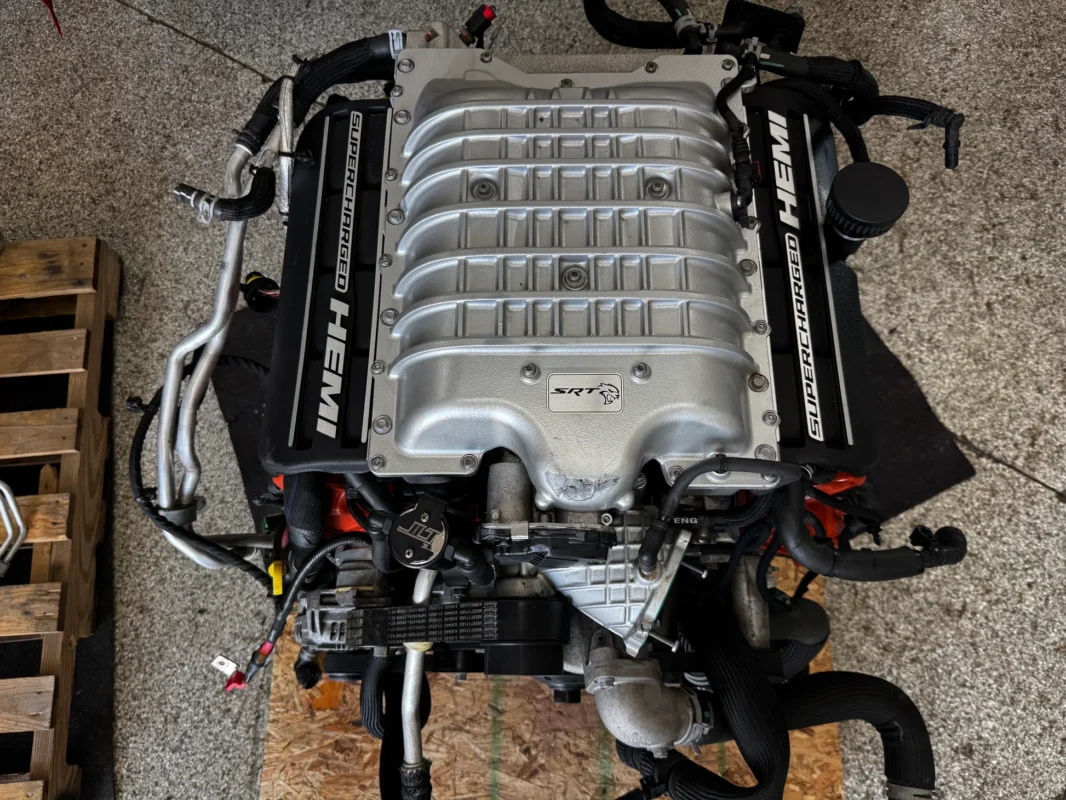
The Redeye and Super Stock configurations use a revised supercharger inlet and a different pulley ratio producing approximately 14.5 psi of boost. The inlet difference is visible compared to the standard Hellcat supercharger configuration.
When examining a Hellcat engine represented as a Redeye, confirm the supercharger inlet configuration visually against reference photos of known Redeye supercharger assemblies. The inlet size difference between the standard and Redeye configurations is a meaningful visual identification point.
Supercharger Casting and Part Numbers
The supercharger housing carries casting and part number markings that identify the specific unit. These numbers can be cross-referenced against factory parts documentation to confirm whether the supercharger is the standard Hellcat unit or the Redeye configuration.
RPO Code and Build Documentation
For engines accompanied by donor vehicle documentation, the RPO code and factory build documentation provide the most complete and most reliable variant identification.
RPO Code Location
The RPO code label is located inside the vehicle, typically in the glove box or on the driver’s door jamb area depending on the model year and application. The RPO label lists the option codes for every significant component on the vehicle as it left the factory.
For Hellcat identification, the relevant engine RPO codes are as follows.
| RPO Code | Engine | Application |
|---|---|---|
| EZH | 6.2L Supercharged HEMI, 707 hp | Standard Hellcat Challenger and Charger |
| EZH | 6.2L Supercharged HEMI, 797 hp | Redeye Challenger and Charger |
| EZH | 6.2L Supercharged HEMI, 807 hp | Super Stock Challenger |
Note that EZH appears across standard Hellcat, Redeye, and Super Stock applications because all three use the 6.2L supercharged HEMI. Distinguishing between variants from RPO documentation requires reading the full option code list on the build sheet, where the specific model line, appearance package, and performance package codes will differentiate the configurations.
Factory Build Sheet
The factory build sheet or broadcast sheet is the most complete factory documentation of a vehicle’s original specification. When a seller provides the build sheet from the donor vehicle, it lists the specific engine, transmission, option packages, and configuration codes as they were assigned at the factory.
Build sheets for Hellcat vehicles list the specific powertrain configuration in detail. The presence or absence of the Redeye package designation on the build sheet is the most reliable single document for distinguishing a Redeye from a standard Hellcat when the physical engine is not accessible for direct inspection.
Window Sticker and Monroney Label
The original window sticker or Monroney label from the donor vehicle lists the engine specification in plain language alongside the option packages. For vehicles where the original sticker is available, it provides straightforward confirmation of the engine specification in the most readable format.
Online VIN decoder services maintain databases of factory window sticker information for many vehicles. Entering the donor VIN into a reputable VIN decoder service can retrieve stored window sticker information even when the physical sticker is no longer with the vehicle.
How to Confirm a Hellcat Engine Before Purchasing
Using the identification tools covered in this guide, here is a practical process for confirming a Hellcat engine before committing to a purchase.
Step 1: Request the Donor VIN
Ask the seller for the complete 17-character donor vehicle VIN before discussing price or committing to a purchase. A legitimate used engine seller who sources engines from documented donor vehicles can provide this without hesitation.
Step 2: Decode the Donor VIN
Decode position 8 for the engine code and position 10 for the model year. Cross-reference the model year against the Hellcat production timeline to confirm the year is within the expected range for the variant being represented.
Step 3: Run the VIN Through a Decoder Service
Enter the donor VIN into a reputable VIN decoder service. Several free and paid services maintain databases of Chrysler production records and can return the engine specification, option codes, and in some cases the full window sticker information for the donor vehicle.
Step 4: Request Photos of the Engine Stamp
Ask the seller for photos of the machined engine pad stamp or VIN tag on the engine block. Confirm that the partial VIN or engine number on the stamp is consistent with the donor VIN provided.
Step 5: Request Photos of the Block Casting Number
Ask for photos of the block casting number location. Cross-reference the casting number against 6.2L Hellcat block casting references to confirm the block casting is consistent with the represented application.
Step 6: Confirm the Supercharger Configuration
If the engine is represented as a Redeye, request photos of the supercharger inlet configuration and cross-reference against known Redeye supercharger reference photos. The inlet size difference between standard Hellcat and Redeye configurations is visible in photos.
Step 7: Request Build Documentation If Available
Ask whether the seller has the factory build sheet, window sticker scan, or any original vehicle documentation from the donor vehicle. Not every seller has this, but when it is available it provides the most complete confirmation of the variant specification.
Step 8: Cross-Reference Everything
If the donor VIN, engine stamp, block casting number, supercharger configuration, and any available build documentation all tell the same story, you have a well-documented engine purchase. If any of these sources conflict with the others, investigate the discrepancy before committing.
Common Identification Mistakes to Avoid
Relying on the casting number alone to identify the variant. The block casting number identifies the block family but does not distinguish standard Hellcat from Redeye or Super Stock. Variant confirmation requires the VIN and build documentation in addition to the casting number.
Accepting mileage claims without VIN verification. Mileage stated by a seller without a verifiable donor VIN is not the same thing as documented mileage. The donor VIN allows you to verify the vehicle’s history through multiple independent sources.
Assuming all 6.2L supercharged HEMI engines are interchangeable. The standard Hellcat, Redeye, Super Stock, and TRX variants share the displacement but differ in supercharger configuration, piston specification, and calibration in ways that matter for replacement and swap applications.
Not requesting engine pad photos. The engine pad stamp is one of the most direct links between the engine and the donor vehicle. Not requesting photos of this area before purchasing leaves a documentation gap that is easy to close with one additional photo request.
Confusing the block casting number with a part number. The casting number identifies the block casting design. The part number identifies the complete assembled component. These are different numbers in different locations and serve different identification purposes.
Frequently Asked Questions
Where is the VIN stamped on a Hellcat engine?
The engine carries a pad stamp on a machined surface on the block, typically near the front or on the side of the block depending on the production year. The stamp links the engine to the original donor vehicle VIN. Request photos of this area specifically when evaluating a used engine purchase.
How do I tell a standard Hellcat from a Redeye by the engine?
The most reliable visual difference between the standard Hellcat and Redeye supercharger configurations is the inlet size. The Redeye uses a larger supercharger inlet than the standard Hellcat. Build documentation from the donor vehicle is the most definitive confirmation, but the supercharger inlet is a useful visual reference.
What is the block casting number on a 6.2L Hellcat?
The block casting number is cast into the block surface and identifies the block casting family. The specific casting number for the 6.2L Hellcat block differs from other HEMI displacement castings. Cross-reference the number against established Gen III HEMI casting number references from reputable Mopar technical communities to confirm the casting is consistent with the 6.2L Hellcat application.
Can I look up a Hellcat engine by VIN?
Yes. Entering the donor vehicle VIN into reputable VIN decoder services returns the engine specification, option codes, and in many cases the window sticker information for the original vehicle. This is one of the most useful tools for confirming a used engine’s represented specification before purchasing.
What RPO code identifies the Hellcat engine?
The RPO code EZH identifies the 6.2L supercharged HEMI across standard Hellcat, Redeye, and Super Stock applications. Distinguishing between these variants from RPO documentation requires reading the full option code list on the build sheet rather than the engine code alone.
Does the TRX use the same engine identification numbers as the Hellcat car engines?
The TRX uses a different VIN structure as a Ram truck application compared to the Challenger and Charger car applications. The engine VIN position encoding differs between car and truck applications. When cross-referencing a TRX engine against donor VIN documentation, use Ram truck VIN decoding references rather than Challenger or Charger references.
What documentation should a used Hellcat engine seller provide?
At minimum, the seller should provide the complete donor vehicle VIN, photos of the engine pad stamp, and photos of the block casting number location. Build sheet documentation, window sticker information, or a VIN decoder report adds additional confirmation. A seller who cannot provide the donor VIN is asking you to accept claims without the means to verify them independently.
Summary
Identifying a genuine 6.2L supercharged HEMI and confirming its specific variant requires using multiple identification sources together rather than relying on any single number or the seller’s description alone.
The donor vehicle VIN confirms the engine application and model year. The engine pad stamp links the engine to the donor vehicle. The block casting number confirms the block family. The supercharger configuration distinguishes the standard Hellcat from the Redeye visually. Build documentation from the donor vehicle provides the most complete variant confirmation when available.
Used Hellcat engines from documented donor vehicles with verifiable VINs, consistent casting numbers, and matching engine stamps represent the most reliable purchases in this market. When those sources tell the same story, you have a well-documented engine. When they do not, you have a reason to ask more questions before committing.
At McClain Auto Part, every Hellcat engine we sell comes with donor vehicle documentation available before the sale is finalized. Call us at +1(216) 230-5433 or email sales@mcclainautopart.com with your application details and we confirm variant, mileage documentation, and casting number information before you commit to anything.
